An odd title for an odd post. A year ago I began shooting film with my new medium format folding camera. I shot 7 rolls of film, took 4 to the camera store, keeping back 3 for me to learn the process of developing, another project that was consigned to the dustbin of overwork. The exposed films sat on a shelf mocking me every time I saw them, a constant reminder of failure.
With my new found enthusiasm and commitment I finally got off my backside and headed down town to Sauter Munich's largest camera shop and one that still actively promotes and supports film photography. OK, I should have developed them myself, but a step at a time. A week later I had a bit of work to do with my scanner. The films were over a year old, so it was quite interesting to see what I was thinking back then. One of the rolls was some nice snow scenes, pretty, but more an exercise in exposure latitude than anything else. The other two, however, were rather interesting.
One of the films was shot on a hard winter day whilst walking along the Isar river. My mood at the time was very bleak, I was struggling with the course and losing confidence in myself as a photographer, I think the photographs reflect that feeling.
I have slightly cropped the first photograph, there was some distracting detail to the right side, however, this is the only photo I have cropped. I find the huge viewfinder allows me to frame more accurately and the square format somehow makes achieving verticals easier.
Once in the trees the bleakness of the landscape really comes out, and again the framing is far more carefully managed than with Digital, every photo was clearly thought about and planned.
There is also something about medium format and the softness of background blur that works for me visually:
The photographs in the woods along the river bank reflect what I was feeling and also perhaps a longing to get back to a more considered approach to photography. I am much more in my element walking slowly and thinking about what it is I want a photograph to present. I enjoy looking at a complex scene and trying to work it out in a photograph, wanting to solve the puzzle of representation. When shooting people I don't have that sense of reflection and have to work far faster than I am comfortable with. I enjoy street work, but am more drawn to the framework of the street rather than the people occupying that space. The people become ornaments, not subjects.
During the past year I have thought a lot on the topic of representation of the world I experience and what I want to say as a photographer. It must be personal and it must somehow capture my world view. I am increasingly disillusioned by the modern corporate world and consumerism and yet at the same time captured by it. I begin to think of myself as an addict trying to kick a habit. The question will be how to translate that feeling into imagery, no answers yet, maybe in a few years I may develop something.
In the mean time my last roll of Tri-X was heading in that direction. I spent some time exploring a very fashionable shopping arcade in the city, the images reflecting an interest in the space and what was on sale there. These are not critical photographs, at least not in the way I present them here. Juxtaposed against some of the urban poverty I also see around me they might have a different meaning. Again, food for thought for future studies.
Really more of an experiment in shape and form, than social commentary. However, these images give me confidence in the capabilities of film and my GF670. There is a different look, the photographs are more considered and I like the texture of the grain in the film, it somehow conveys the physicality of film. I don't buy into much of the psychobabble about film versus digital, but it is certainly different both in practice and result. Better, nope, but there is a value here, I just need to understand it more and work out how and if to include in my workflow.
I also notice in these images and in the final outcome of my Fest project that I work better with melancholy subjects, than with light and joy. I have been trying to avoid the photographic cliche of imaging "The Other", revealing what that is broken in society, rather than seeking what works. I feel there is a risk of continually portraying problems rather than solutions, however, one look at the evening news reveals that we are drawn to bad not good news. My initial thoughts about assignment 4 were to do something bright and happy, people enjoying themselves. I am now questioning this. Not because I think it is wrong, in fact I think it would be a better more real study, but it might not be something I can do well. With Fest, I started in colour celebrating the mad joy of the event, I ended in B&W portraying the casualties. It was clear what worked better. I simply do better making photographs that reflect my mood, and my mood is not a bright one these days.
Tuesday, January 21, 2014
Sunday, January 19, 2014
Assignment 3: Essay Completed
It took a little longer than I expected, but I finally got the essay in the mail to my tutor this week. Now the wait for feedback. With my last essay for Landscape on Andreas Gursky I was quietly confident that it was a good piece of work, I was very much into the artist and thought I had something interesting to say - my tutor agreed.
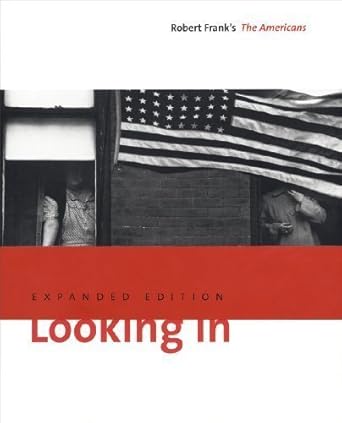
With Robert Frank I am on less secure ground. Rather than making the process easier the vast amount of published information, in particular Sarah Greenough's "Looking In Robert Frank's The Americans", made the task very much harder. What could I say that was not simply a precis of what was already out there, 2,500 words seems like a lot, but is in fact a very short piece of writing. I immediately struggled with the scope of the task I had set myself and quickly realized that I could not write a meaningful essay that covered Frank's complete life and works.
My initial thoughts had been to look at The Americans and analyze how it had changed photography, a kind of before and after with a brief biography of Frank. My own interest in photography and photographers is very much orientated around this before and after. I have collected photobooks by Hine, Evans, Stieglitz, Adams (A), and Steichen. They all share a careful approach to photography, technically excellent and visually correct. After The Americans came Winogrand, Arbus, Klein, Meyerovitz, and Shore, all embracing the snapshot aesthetic and publishing volumes of work taken with small cameras often of events and stuff that crossed them in the street. As with all transitions this is not clear cut and happened over time, but there is a distinct PF and AF in american photography.
The problem I had was that writing an essay about this would be to rehash the topic once more and what would I learn from it? Sure there is a historical element here, but I already get that. 3 feet of bookcase are testament to the fact that I have explored these photographer's works. I still think there is value in looking at each of these photographer's contributions and analyzing them in the context of my own thinking, but not for my essay.
In the end I decided to make this personal and look at Frank through the lens of what I could learn from his development as a photographer, what did he do to get to the point of writing The Americans. This meant asking questions about his earlier work. One thing was immediately apparent. Although we refer to the young Frank at the time of publication of the Americans, he had already been working as a professional photographer for 17 years by then. So what had he been doing for those 17 years?
This became the theme of the essay and was the first time I had really looked at how an artist developed over time versus considering the finished item of a photograph or book. There was a risk in this approach as my essay might not be "academic" enough, however, the key was that I learned a lot by doing this, a more conventional approach to Frank would have taught me nothing. The final result is not really the point for me here it is the process to get there. Writing the essay took roughly 6 full days of research and development. During that time I steeped myself in the young Frank and his early photographs.
So what were the conclusions? I finished the essay with the following observations about Frank and what I took from his development:
With Robert Frank I am on less secure ground. Rather than making the process easier the vast amount of published information, in particular Sarah Greenough's "Looking In Robert Frank's The Americans", made the task very much harder. What could I say that was not simply a precis of what was already out there, 2,500 words seems like a lot, but is in fact a very short piece of writing. I immediately struggled with the scope of the task I had set myself and quickly realized that I could not write a meaningful essay that covered Frank's complete life and works.
My initial thoughts had been to look at The Americans and analyze how it had changed photography, a kind of before and after with a brief biography of Frank. My own interest in photography and photographers is very much orientated around this before and after. I have collected photobooks by Hine, Evans, Stieglitz, Adams (A), and Steichen. They all share a careful approach to photography, technically excellent and visually correct. After The Americans came Winogrand, Arbus, Klein, Meyerovitz, and Shore, all embracing the snapshot aesthetic and publishing volumes of work taken with small cameras often of events and stuff that crossed them in the street. As with all transitions this is not clear cut and happened over time, but there is a distinct PF and AF in american photography.
The problem I had was that writing an essay about this would be to rehash the topic once more and what would I learn from it? Sure there is a historical element here, but I already get that. 3 feet of bookcase are testament to the fact that I have explored these photographer's works. I still think there is value in looking at each of these photographer's contributions and analyzing them in the context of my own thinking, but not for my essay.
In the end I decided to make this personal and look at Frank through the lens of what I could learn from his development as a photographer, what did he do to get to the point of writing The Americans. This meant asking questions about his earlier work. One thing was immediately apparent. Although we refer to the young Frank at the time of publication of the Americans, he had already been working as a professional photographer for 17 years by then. So what had he been doing for those 17 years?
This became the theme of the essay and was the first time I had really looked at how an artist developed over time versus considering the finished item of a photograph or book. There was a risk in this approach as my essay might not be "academic" enough, however, the key was that I learned a lot by doing this, a more conventional approach to Frank would have taught me nothing. The final result is not really the point for me here it is the process to get there. Writing the essay took roughly 6 full days of research and development. During that time I steeped myself in the young Frank and his early photographs.
So what were the conclusions? I finished the essay with the following observations about Frank and what I took from his development:
- The first is to think of photographs not individually, but in relation to one another, bound together by a common narrative. Frank showed in his early work that this narrative need not be temporal nor linear, but a body of work should have linking themes that ask to be understood by the reader.
- The second is to consider photography in the context of other contemporary movements, artistic, but also societal, to incorporate the zeitgeist into my work.
Hopefully my next blog entry will be job well done, but if not, another learning experience beckons.
Friday, January 3, 2014
Assignment 3: down to writing
The dreaded essay, 2,500 words of torture. Well, not really - I have spent much time prevaricating over writing the essay, but in truth it is the easiest of the assignments, a research project combined with a learning transfer. My problem has been that the essay ties me to a keyboard, something I have spent far too much time doing recently, my photography is an escape from the office and computer.
However, I have 4 free days now, before returning to work; nothing else is planned and whilst I can think of things I might enjoy more than writing this essay, it is not a bad way to spend my time and is something that will grant a much needed sense of achievement once completed. As ever getting down to it is the hardest part and as with all large projects the trick is to divide the work into manageable lumps that I can digest individually and then assemble as a whole.
The first step is research, learning enough about my subject to be able to say something definitive. My subject is Robert Frank and the spin will be around how he changed the nature of documentary photography with his seminal work, The Americans. Not terribly original, perhaps, but his work has been a constant influence on me for the entire course so far and I feel a deeper investigation will benefit my work. There are a few threads that I want to investigate:
However, I have 4 free days now, before returning to work; nothing else is planned and whilst I can think of things I might enjoy more than writing this essay, it is not a bad way to spend my time and is something that will grant a much needed sense of achievement once completed. As ever getting down to it is the hardest part and as with all large projects the trick is to divide the work into manageable lumps that I can digest individually and then assemble as a whole.
The first step is research, learning enough about my subject to be able to say something definitive. My subject is Robert Frank and the spin will be around how he changed the nature of documentary photography with his seminal work, The Americans. Not terribly original, perhaps, but his work has been a constant influence on me for the entire course so far and I feel a deeper investigation will benefit my work. There are a few threads that I want to investigate:
- How Frank developed as a photographer, his learning processes and the route that led to The Americans. This is in a sense more interesting than the finished work of The Americans as I can learn more about my own journey from how he built an education in photography.
- How Frank's work influenced those who followed and how he contrasts to those who came before - was Frank the pivot around which 20th century photography turned?
- Frank's working method, I think this had as much influence on other photographers as his actual published material, he rejected the careful framing and calculations of Adams and Stieglitz, for what we now see as the seemingly modern funnel approach to photography, shooting thousands of frames and then progressing through a step-wise reduction to a final published set.
- Finally, what do I take from this, what do I learn? Why did I choose to study this man and his work?
My basic model for the writing the essay is the following:
- Gather printed material. I started with the book, "Looking in Robert Frank's The Americans" a doorstep of a book, hugely useful, but almost too much material. I also have 7 of Frank's photo books, bother pre and post The Americans to use as a visual reference.
- Search the Internet. I have used the Wikipedia entry as a starting point. In itself it is pretty sparse, but the references provide links to much more detailed information.
- The hard part - reading all this stuff and extracting the elements of information around which I will hang the thesis of the essay. Much use of highlighters and post-its (I cannot bring myself to actually write on a book - heresy).
- Create an outline with the larger subject headers - basically a series of questions that I need to answer
- For each subject header generate a paragraph list that ties the facts and quotes from my research into the framework of the essay.
- Write a first draft
- Review and think a while...
- Write a second draft and get Heidi to proof read for me
- Add in references and clean up for final submission
My biggest challenge at the moment is to avoid over-working this process, the essay should be a learning experience that helps me to place my work within a historical context, it is not an end in itself and as a 2nd year undergraduate I am unlikely to add any new thinking to a very crowded commentary.
Next step - read the pile of printed web articles and speed read the following:

I bought this 3 years ago from Amazon, was then an expensive book at 38 pounds, but is now advertised as 149 new (phew!)
Tuesday, December 31, 2013
A year ends...
And what a year, zero progress as a student with the OCA, getting preciously close to giving it all in. The death of someone very close to me at the end of 2012 was followed by a dramatic change in my working circumstances. Somehow these combined to knock me off my photographic feet and I never managed to get up again.
In this blog I have documented a few plans, false dawns that ultimately led nowhere, I could never gather the necessary momentum to restart my work. The fundamental challenge is time, through 2013 worked an average 60 hour week, 12 hours a day sitting opposite a computer keyboard - I start around 7am and work until 7pm, or later if I am foolish enough to take a lunch break. The work is highly pressured and intellectually demanding, there is little left in me at the end of the day and the weekends have become an alcohol assisted recovery (assuming I am not working over the weekend to catch up on something). In December work finally eased off and I was able to plan a 3 week break over Christmas, time to catch up (and consume unused vacation time). A trapped nerve in my neck ended any hope of using the time for photography - my work still had the last laugh, with the parting gift of an RSI typical for a keyboard based worker. The steroid injection in my spine was less painful than the condition, grrr.... I have to be careful not to complain too much, it is a good job and well paid, there is simply too much of it.
The net is that once again I am writing a blog entry trying to make sense of where I am and where to go next. My blog is becoming a diary of angst and stress rather than a celebration of my learning, however, it is therapeutic and writing this stuff down helps me to organize my thoughts. So, with the end of the year and the start of a new one I arrive at a decision point, I must find a way to re-incorporate the OCA into my life or be honest with myself and accept that my attempt at an arts degree has failed. This is within my control, it is my choice.
As I reflect on 2013, it was not all bad, I have had two photos published in the Big Issue in the North,this was in the 1-7 July issue:
I also photographed two weddings, one in the North of Ireland, another in Denmark (not blogged yet), plus the engagement of a Turkish couple here in Munich. Note to self - start asking for money:)
A super trip to the Philippines yielded some great underwater imagery.
What came as more of a surprise was the use by the OCA of two of my photographs. I came across these by accident, browsing the new OCA web site and spotting them. Both are images from my final assignment for People and Place and show scenes of Munich subway stations. The first adorns the cover of the newly rewritten DPP course:
The other is an illustration on a web page outlining the Writing Skills course in the Creative Writing degree pathway on Oca-uk.com
It might have been nice to be informed of their use, but no problem really, I am just delighted that my work is held in high enough regard to be used by the OCA in their own material. This cheered me up immensely and reinforced the link that I feel to the college.
This brings me back to where I am and where I am going.
I have written to the OCA office to ask about my options. I have two years to complete Social Documentary, that time runs out in June. I asked for extra time, answer was no, my reasons are not good enough. I also have until Sept 2016 to complete my year 2 studies. This leaves me with three options:
In this blog I have documented a few plans, false dawns that ultimately led nowhere, I could never gather the necessary momentum to restart my work. The fundamental challenge is time, through 2013 worked an average 60 hour week, 12 hours a day sitting opposite a computer keyboard - I start around 7am and work until 7pm, or later if I am foolish enough to take a lunch break. The work is highly pressured and intellectually demanding, there is little left in me at the end of the day and the weekends have become an alcohol assisted recovery (assuming I am not working over the weekend to catch up on something). In December work finally eased off and I was able to plan a 3 week break over Christmas, time to catch up (and consume unused vacation time). A trapped nerve in my neck ended any hope of using the time for photography - my work still had the last laugh, with the parting gift of an RSI typical for a keyboard based worker. The steroid injection in my spine was less painful than the condition, grrr.... I have to be careful not to complain too much, it is a good job and well paid, there is simply too much of it.
The net is that once again I am writing a blog entry trying to make sense of where I am and where to go next. My blog is becoming a diary of angst and stress rather than a celebration of my learning, however, it is therapeutic and writing this stuff down helps me to organize my thoughts. So, with the end of the year and the start of a new one I arrive at a decision point, I must find a way to re-incorporate the OCA into my life or be honest with myself and accept that my attempt at an arts degree has failed. This is within my control, it is my choice.
As I reflect on 2013, it was not all bad, I have had two photos published in the Big Issue in the North,this was in the 1-7 July issue:
I also photographed two weddings, one in the North of Ireland, another in Denmark (not blogged yet), plus the engagement of a Turkish couple here in Munich. Note to self - start asking for money:)
A super trip to the Philippines yielded some great underwater imagery.
What came as more of a surprise was the use by the OCA of two of my photographs. I came across these by accident, browsing the new OCA web site and spotting them. Both are images from my final assignment for People and Place and show scenes of Munich subway stations. The first adorns the cover of the newly rewritten DPP course:
The other is an illustration on a web page outlining the Writing Skills course in the Creative Writing degree pathway on Oca-uk.com
It might have been nice to be informed of their use, but no problem really, I am just delighted that my work is held in high enough regard to be used by the OCA in their own material. This cheered me up immensely and reinforced the link that I feel to the college.
This brings me back to where I am and where I am going.
I have written to the OCA office to ask about my options. I have two years to complete Social Documentary, that time runs out in June. I asked for extra time, answer was no, my reasons are not good enough. I also have until Sept 2016 to complete my year 2 studies. This leaves me with three options:
- Quit the OCA
- Complete Soc Doc in the next 6 months. I have 3 assignments to complete, although most of the photographic work is done, so not an impossible hurdle.
- Quit Soc Doc and start a new course - Documentary.
OK, I am not going to quit OCA, it might happen by default if I run out of time, but I will not consciously make that decision. That leaves options 2 and 3. The new course is attractive as it would provide a good stepping stone to Level 3. I am concerned that I have recently gone backwards rather than progressing. However, I have some good material for the current course and I feel I should try and complete. If I fail to make the deadline then I will have to do option 3. So my decision is to continue with SD and try and make the June deadline for the 3 remaining assignments - going to need to start on the essay pretty soon...
All of this can only happen if I get my life in order and find a way to get out from under my current workload. the good thing is that my managers are all aware that we cannot keep up this workload without something breaking (in my case my neck was the indicator that the break was coming). I also need to start getting out of the house more often and reduce my reliance on alcohol to relax on the weekends.
3 weeks ago I had my 50th birthday, so now is a time to start thinking about the rest of my life, what I want to do with it, and most importantly how long it is going to be. Changes are needed and I plan to use the OCA as a vehicle to make those changes. I must make time for my course and that can only come from a reduction in my working week, so here is where I must start. Will not be easy even with the law in Germany making a working week of more than 48 hours illegal. However, I must find a way to say no and work smarter to avoid our perennial fire drill exercises. Alcohol, well that one is easy enough to manage, just needs some will power and the realization that I am no longer 20. Exercise, camera in hand a long walk can be a journey of discovery.
Thinking back on my photographic work, I think this year long break might actually help, it has allowed me to reflect on what I am interested in. While I have done little real work, I have spent many nights awake thinking about it. The corporate world and its collision with society is a theme that I would like to explore further.
Next stop a pile of books about Robert Frank.
Saturday, September 7, 2013
Assignment 4: First Thoughts
Assignment 4 belongs with Assignment 3, indeed it should follow on from 3, but I seem to have developed a phobia towards essay writing, I am sure I am not unusual in that sense. This is down to simple laziness, essay writing is too much like work, I take photos because it is fun, essay writing isn't...
Ah well, I will fix that soon, however, in the mean time here is some musing on Assignment 4. Although, this is my first formal post on the topic of Assignment 4, I have been working the material for the assignment since the day I started the course. The subject for my essay is Robert Frank and although I do not plan to place my focus on "The Americans", that book is the motivation for the subject of this assignment. When I started the year I though about creating a book from this assignment, however, my struggle with the Fest book for assignment 2 showed me that I need to take care not to be led astray from the primary goal of creating 12 photographs. I still believe that the photobook is my ultimate expression as a photographer, the gallery wall does not appeal (yet). However, books are complex things that take considerable time to develop. Whilst I found creating Fest completely exhausting it was also a great learning experience, but one that I do not need to repeat now. I probably will create a book from this and other material, but after I finish this assignment. I still need Christmas presents for friends.
So what is it about Frank and the Americans that I want to "be in the style of". First of all, I have no intent to try and replicate his visual style or content. That has been done, it was his great contribution, but it is not mine. What I want to do with this assignment is to adopt his way of looking, to place myself in his shoes, in his case a European looking at America and recording his response to the place and people through the medium of photography. In mine, a Brit looking at Germany. I will retain the small camera and also black and white - I am still interested in the qualities of B&W and want to explore further in this assignment. The small camera is easy, it is all I have. However, I am not using my DSLR for this assignment, I am using a mix of different mirrorless compacts, both interchangeable and fixed lens. But, this is not about technology it is about narrative and context.
Although I planned a year on this project it fell into the stupor of my disillusionment. 6 months passed without any new material. I am back and am now adding new material to what I captured a year ago.My subject is also more constrained, I don't have the time or money to span the country shooting 80 or more photos a day for a year. Currently I am thinking about the following, the people of Munich is the subject and their leisure the narrative. Subsequently this will be about people and what they do in their spare time, although I will also look at those tasked to service their leisure. Conceptually this is not as well developed as Assignment 5, but is more mature in terms of material. I probably have what I need for a sound response to the brief, but am not yet ready to say stop. I plan a few more shoots in and around the city, hopefully later today which will yield another post with new material.
This post is designed to present my current visual thinking and establish a start point. There are a few more than 12 images here so this is not intended to act as a candidate set.
I start with people sitting down, nicely arranged in rows for my camera. The first is a favorite, I simply like Joe Cool in the center, totally relaxed and confident, surrounded by a group of girls who look anything but relaxed. Not quite sure what the narrative is, but it has potential
I like layers and reflections
This is all about being grumpy
Michael Jackson fans hang out at the memorial to his life. Weird, they are always there on the weekend and it is a while now since he passed. Like this one a lot...
Back to people in boxes
It is all in the expression, group of American tourists, Muencheners for the day
Shopping
More cool in the city
Listening to a political rally - the mayor is just off camera to the left
Another favorite, I am drawn to people taking photographs.
As with most societies, isn't it odd that most sponsorship for healthy living and sports comes from the companies whose products make us fat in the first place. More layers and straight lines...
Echoing my work at the Oktoberfest
Bavaria is one of the most conservative parts of Germany, but Munich the state capital is the exact opposite, reveling in it's alternative lifestyles. This is the annual Christopher Street parade when the gay community celebrate in a mad explosion of sound and colour (well B&W colour). This photo is made by the people watching.
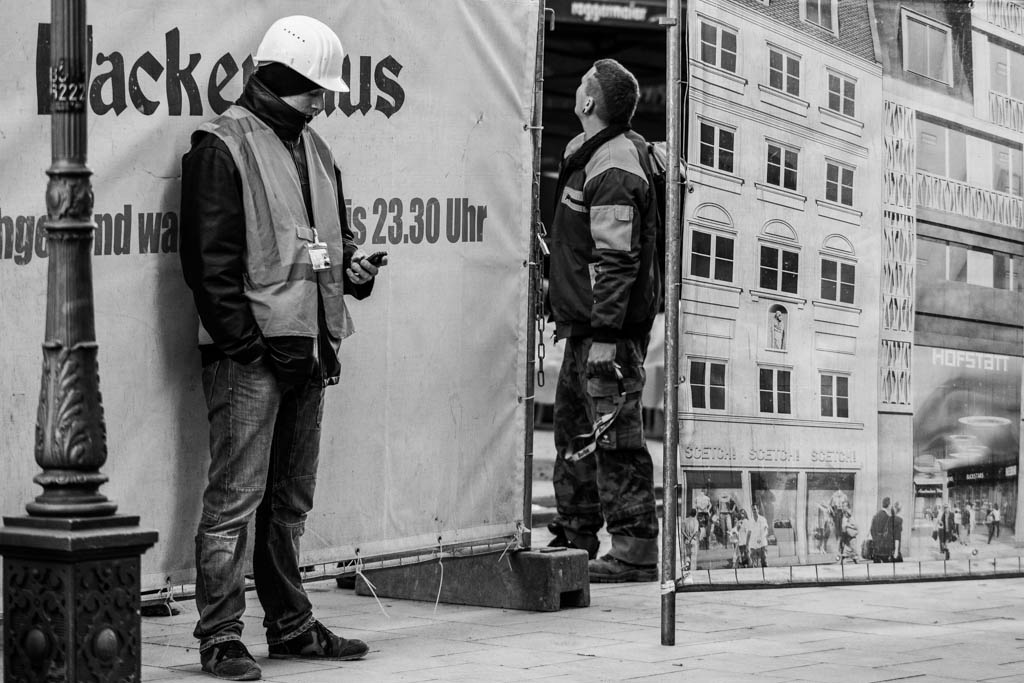
A visual puzzle for a rainy Saturday afternoon in the center of the city. Munich is gradually improving the underground railway system, these hoardings hide building works.
Maybe work rather than leisure, but this works with the other images
As I have often stated elsewhere, people do not like being photographed. This is someone who serves the beer in the beergarden, his shyness might reflect the fact that he is almost certainly not German and probably not legal. Many people working in the service sector do so in the grey
Service at a large beerkeller.
In the Keller, wonderful place, superb beer and the rudest waiting staff in Munich, well worth a visit.
The mayor, Christoph Ude pitches to the crowd at a street beer fest. Frank was very interested in the American political process, I am less so in that of Germany, but this is still a possible element of the narrative
Summer
Summer
Summer at the lake. The last two photos were in the city center, this is lake Amersee, a popular day out for the population of the city.
Impromptu brass band. They had been playing at a local church parade and then did what people in lederhosen do on a bank holiday afternoon, went for a beer or two. The beergarden offered said beer for free in exchange for an occasional song.
A little different from the other images here, this is the dancing at a Turkish engagement party that I photographed and blogged a couple of months ago. Not quite sure whether to include it, it certainly illustrates a great part of modern German culture
So far I have been very much focused on people as the subject for this assignment, however, not all of Frank's images included people. Mid winter and at the time I was playing with shape and form. However, the advert on the bus shelter is very telling of German society. First of all it is fashionably in English providing a degree of cool, secondly it is for cigarettes, and finally the phrase seems very prophetic to me. I am sure that "No More Maybe" is not meant to convey what I read; I read no more maybe cancer, this product really will kill you.
As an aside I am also thinking about working a project around cigarettes and the smoking culture in Germany...
A start and I think a reasonable one. I have been working this for over a year and so should be in a reasonable position. It needs refinement and perhaps a few new photographs.
Assignment 5: Progression
My biggest question for this assignment is finding the meat in the sandwich that I have created. The two strip photographs that started this train of thought work and I believe are an interesting way to present a study of a street. The problem is then creating the story, finding imagery that makes the space between the buildings come alive. First of all this is very firmly a street photography exercise, in name, but most importantly from the standpoint of style and approach. However, I need to be careful, this is my neighbourhood, somewhere I live, a street that I cross almost everyday, containing my pub and my cafe. Street photography can be intrusive and prone to confrontation in today's suspicious world. I don't want to risk becoming persona non grata in my own home. This is already a challenge, I have had one small confrontation, not a problem, but something I need to manage carefully, especially with my dodgy German. Although, that actually might help, officials snooping on the locals are most likely to speak the local language rather well. Germany and in particular the immigrant community have a healthy and understandable distrust of officialdom. Street photography is quasi-legal here, so I need to take care.
My approach so far has been to simply take a half hour every so often and walk up and down the street camera in hand. I am relying on serendipity, I have no specific topic in mind, simply opening my eyes to the world and grabbing opportunities as they arise. I also look for places where I can stand and observe waiting for a photo to coalesce in front of me, trying to blend into the background. Once I gather enough material to form a basis for a set, I will then need to think in terms of specific elements that might be missing. Where I am going with this study is an illustration of modern German society in the context of where people live their lives. The risk is that this might be bland, there is no sensational aspect, I am not digging into poverty, homelessness, abuse. I could do this, but it would be dishonest, Germany is a real place containing real people, doing the ordinary things that make life work. Too often Germany is painted either through the medium of the past or as a jolly knees up in leather and silk. I want to show the Germany I know and love, a place to live. Assignment 2 started in colour and fun, but ended in misery and grime. This time I want to present a counter to that view.
A big change for this assignment will also be a move from B&W back to colour. Colour is my medium, madly saturated bold hues, building on my first photographic love - the kaleidoscope of the coral reef. With this course I wanted to explore a different approach, taking a chance to play in B&W before the more serious world of final year work. However, a study of modern Germany needs colour, Germany is very colourful, colour are used far more boldly than in other societies. This is very visible in the buildings that make up Richard-Strausse Strasse, but also in the clothes people wear, although not in the very boring car colours popular at the moment. SO colour it is!
A street offers many different subjects, but they can be grouped into 3 essential elements, people, details, and architecture. I am covering the architecture using the strip photos, but there are still some elements that might warrant closer attention. Details are fairly straightforward to capture, the challenge is more around the context and making a photograph that offers more than a simple record. People are my primary challenge. In Germany it is illegal to publish a photograph of a person without their written permission, exceptions exist for the newsworthy, however, the general public are protected. On the other hand you can present a photograph in which a person is incidental to the scene, not the clear subject of the photo. The net effect is that German street photography does not exist, German photographic artists tend to be studio based or work with landscape, Helmut Newton and Andreas Gursky are good examples of the two. I am prepared to break the rules and have done so in the Fest series, but these were people in a very special place and often pissed out of their brains. The gentle folk of Richard-Strauss Strasse take their privacy rather seriously and so it is unlikely that I am going to create many close up photos without carrying around a set of legal documents. Not my style.
The result is that many of my photos involving people will be stepped back, not the in your face street style that characterizes Garry Winogrand or William Klein, perhaps more the observational style of Joel Meyerowitz. My first example and a photograph I like very much is the following. The two guys on the right were chatting away, but as the girls approached their attention clearly shifted and the sizing up process is clearly present. All are probably from the Turkish community, the largest non-German ethnicity in the city. A simple thing, but a daily part of the too and fro between the sexes.
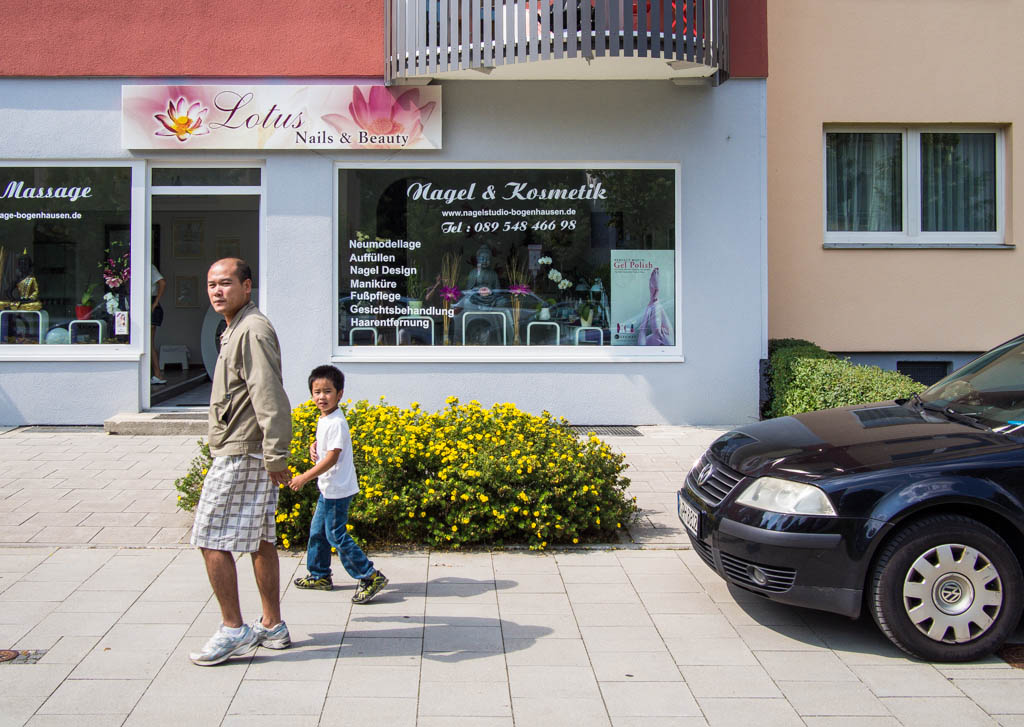
Another large immigrant community in Munich is Asian, often Vietnamese, the former link between East Germany and communist Vietnam led to many Vietnamese coming to Germany for education and then staying on. This family (no idea if Vietnamese or not) run a local beauty and massage business, they have a shop on the west side of the street. Here I had my first confrontation, they were not happy with me photographing the shop, although that dissipated once they relaized that I was not German. It is possible that all is not fully legal, many people work in the Schwarz (Black) economy, taxes not fully paid, resident status not quite as it should be.
This photo captures another element of Munich life, people here walk, run, and cycle a lot. Although the traditional image is the jolly fat beer drinking Bavarian, they are in general a very fit people, even the overweight use their bikes for local shopping. Cars are an obsession, but for long distance travel, anything less than a couple of miles away is accessed using leg power. Jogging is very popular, even I have been know to go for a run,
Basic is an institution here, although a very middle class one. The supermarket is organic, everything inside is "Bio", pronounced Bee-Oh. This is a full service supermarket selling everything you need, not just food, soap, toilet cleaners, paper products, everything is naturally produced,or with very low environmental impact. The downside is that it is also very expensive compared to the Rewe next door that I normally go to. Like mos supermarkets there is a also a small seated area outside so that you an snack on what you just purchased
Another view of Basic, one that appeals more to my desire for things in boxes.
Not sure about the following photo, I like the structure and the giant Wein sign in the right. The man is loading a Mercedes, well done to Dewald for spotting that. It speaks to the fact that even on an ordinary street in Munich most of the cars are Mercedes, BMW, Audi, or for the poorer or young VW. Other makes exist, but Germans buy German cars and are very proud of them.
The Wein sign is painted on the side of Garibaldi's an Italian wine importer that makes for an enjoyable visit. Once again a few seats outside enable them to supplement their income and for customers to try their wares in a comfortable setting. Licensing laws are not a big issue here. Not sure that this works, but like the reflection in the window.
Turning from people to details. We have an election in a week, with local and national seats up for grabs. The city is pasted with posters, they are everywhere. You see fewer billboard images here, it is mostly small signs planted into the ground like the following. I will use one of these in the set, not sure yet which.
I like the next one, she is appealing to the traditionalists, the dirndl and the fredensengel in the background. Many politicians like to adopt a traditional stance, often pictured with a liter glass (Masskrug) in hand, "Vote for me, I like beer", absolutely! Beer and politics are a combination still very much alive in German culture.
Although the bookends for this project are a study of the architecture of the street, I still think their might be mileage in a couple of images that study the shape and form of German businesses or dwellings. This is an optician. Note the bikes, people really use them as a primary transport. Also it is very clean, very tidy.
Not all is well on the street, some business have had a harder time. This used to be a tattooist. Empty and vacant, but still clean and tidy. If you rent any form of premise here you are legally obliged to leave it as you found it, which generally means painting everything white. I have bumped the exposure a little on the Buddha. Again a photo that appeals to my sense of orderliness, guess I am starting to go a little native.
A couple more simple architectural details, the entry to an apartment block and a small business offering driver education.
Aargh, in two weeks it is the Oktoberfest once again. Two weeks of stinky drunken insanity, but worse a year since I worked on my last finished assignment. What a lazy git...
Couldn't resist playing a little with reflections and perspective, probably not good for the assignment, but fun for me.
Very few Germans use satellites for TV, the city is cabled and like me most people get Sky through outlets in the house. However, that is Sky Germany, if you want your own language TV a dish is often the only way. Subsequently a dish is a good indicator that the people who live there are immigrants. It is generally forbidden by the House Ordinances to mount a satellite dish, landlords think they spoil the look of the building, rightly I guess. However, in law people have a human right to broadcast TV from their own culture and if the only way to get that is satellite then that right overrides the House rules.
This is an odd shot, it does both, reflection and perspective. Not terribly documentary, but an alternate view of the street. The effect is created by the fact that the building I am imaging has a triangular cross section and the buildings are not being reflected by the back windows but another window an inch or so in front of the camera.
Mix of comment and architecture. I need somehow to portray the obsession with the car. Yes Germans are fit and love to ride bikes, they are green and terribly energy efficient, but they would die for the right to drive massive cars at 155mph on the Autobahn. 155 is a limit the car makers impose for safety reasons, go figure. Not a great image, something that needs refinement, maybe a few cyclists going past in the background.
This is a beginning and I think not a bad one. There is much work to do, and hey this is Assignment 5, I haven't started 3 yet. But that is now my plan for the course, complete the final 3 assignments in parallel and prepare for next year.
What I hope this is beginning to convey is a picture of an orderly people, but diverse in their lifestyles, not conforming to the English stereotype, but at the same time valuing tradition . On the whole Germans are not very wealthy, they have a median wealth lower than that of the Greeks they so famously are accused of driving into poverty. There is a lot of money, but it is generally held by a small percentage of the population. The split of wealth is quite similar to the US, a small number of the very rich and large number on low income. The difference is that tax is collected and used to improve the lot of all, not bombing the crap out of the enemy de Joure. People are not rich but also not poor, things are not too expensive and the government makes sure that stuff works. Germany is a social and socialist place, where people get along and on the whole try to contrubute to society. This is the story I want to tell.
Subscribe to:
Posts (Atom)