Showing posts with label Projects. Show all posts

Friday, January 24, 2014

P35: a city at night

I might start to become a little self contradictory here.  I stated a while ago that I was giving up on the projects in Social Documentary as they were rather banal in their structure, focusing on technique rather than content or reflection.  However, as part of my gradual rehabilitation as an OCA student I am going to reconsider some of the more interesting projects and complete them, a bit of photographic therapy to restart some thought processes.

Night time photography does fascinate me, I enjoy the challenge of working in marginal situations, especially as I am very averse to using a tripod.  Modern cameras, though, are very forgiving, ISO 3200 and effective image stabilization make possible today what was unthinkable a few years ago. The trick is to balance the artificial light with any remaining natural light and to avoid over exposure. Cameras want the world to look grey and so will do their damnedest to take a dark sky and light it up, blowing out the buildings that were the original subject.  A handheld light meter would fix this, but in practice underexposing by 2-3 stops does the trick most times - and with digital a little chimping can fix most problems.  This works for buildings, with more fast moving subjects, shooting on manual after taking a test exposure of the ambient light is the way to go.  Final comment, flash? Sometimes, a little fill flash can help, but generally only works in dusk light, in night it blows out the foreground and creates a fake looking photo.

With this exercise I am digging into my archives a little as I have a night time subject that I have been working on without really thinking about it for years, Singapore.  Singapore is like a second home for me, I first visited on business 18 years ago and have been back most years, often twice, and last year 3 times.  That was an aberation, especially as none of it was business. I guess I love the combination of west and east, the mixing of so many cultures and the combination of safety with hedonistic pleasure. Many times I have thought about moving there, it is my companies Asian HQ and I have been asked before to go.  Family prevented that move and I think it is now a little late in my career to start again in Asia.  So we try to get there at least once a year, usually on the way to a dive trip somewhere in Indonesia, the Philippines, or Malaysia.

I always take a camera and due to the heat and tropical sun tend to take most of my photographs in the evening.  I try to book a hotel that offers an outlook over the city.  My first photo was taken from my room in the Stamford Swiss Hotel, a giant tower, with balconies overlooking the financial district.  This is an almost iconic view of the city at night, but I have included in the foreground the playing field of the Padang on which people are doing some football practice.  This type of landscape photo helps to frame the location, a statement of where we are.


Another hotel, this time overlooking the east coast express way, the road linking downtown to the airport.  Perching my camera on a desk this is another standard view of a city at night, trying to capture the never ending flow of cars.  I think a key element in city photography is to image the energy and pace of life.


Another hotel, this time the Mandarin Oriental on Orchard Road, nice hotel bad location, miles from anywhere interesting.  However, in my case the construction site opposite was a boon.  They worked all night.  This was another photo with quite challenging exposure, which needed a lot of post processing.  The question is how much detail to show in the surroundings. In the end I opted to light just the construction, yielding this image of the continual construction cycle that is an Asian city.


I have long been an admirer of the work of Michael Wolf and his images of Hong Kong apartment blocks, I am drawn to the uniformity of the patterns broken by the occasional piece of individuality.  This is really marginal as a handheld image, requiring a telephoto and with very dim lighting on the building.  Quality is poor, but I think as part of a sequence it works fine. It is also an important image for me as I tend to be fixated on the hustle and bustle of the bars and cafes at night, forgetting to think about where all these people go.  A small island with a very large population means that most live in towering apartment blocks.


My favorite hotel in Singapore is the Swiss Hotel at Clarke Quay, just on the Singapore river and adjacent to a huge area of bars and restaurants.  Not the cheapest place in the world to eat and suffering from a tourist premium, it is worth it my opinion.


It is a popular hang out for students, although the prices make it not so affordable.  In the middle is a small 7 Eleven that sells ice cold drinks and snacks at "normal" prices.  A lot of people simply buy a 6 pack and hang out on the bridge enjoying the atmosphere.  It makes for a wonderful atmosphere, a big change from home where a large group of young people hanging around drinking on a street would not generate quite the same feeling.


In the tropics dusk is very short lived, and although it is the best light to shoot by, you have to plan ahead and be where you want to be to take a few shots.  Not really my modus operandi, but this is an example of a shot that really worked with the light.  Simply luck, being in the right place at the right time.  It is also a rare example of clouds that weren't dumping a tropical down pour.


All cities like to show off and Singapore is no exception.  The Marina Bay Sands Hotel and Casino is a Las Vegas style complex that wants to be noticed.  Singapore has now overtaken Las Vegas in terms of gambling revenue, although notice that Sands is a Vegas company.  Tricky photograph shot from a moving boat, but taking advantage of my OM-Ds image stabilization and the fact that although it is dark those lasers are very bright.


Same location from the other side


One gem in Singapore and free entry is the gardens by the bay with their impressive artifical rain forest.  These are giant structures covered in tropical plants with a bar at the top of the one in the middle.  Surrounded by water there are plenty of opportunities for intriguing night time photography.


So far it has all been landscape, in a sense the easy stuff, nothing is moving unless of course you are on a boat, but that was my decision.  Much more challenging is to photograph people in this light.  Rather than imaging the lights I now must use those lights to illuminate my subjects.  The first example is relatively easy as everyone is seated and so limited movement.  This is an image that would have been destroyed by flash, the strange coloured lighting provides the sense of the photograph.


Moving people are much harder to frame and shoot.  The cameras focus is slow, the framing harder to judge.  Sometimes you just get lucky.  This is one of my personal favorites from Singapore.  I was trying to shoot the fountain, when the lady in red crossed my path.  The blur adds to the sense of movement and perhaps mystery.


If moving to fast this is what happens, although again I do not think it is wrong, it adds movement to the frame.


I have discussed before my tendency to try and place people in boxes.  Night time is a great opportunity for this type of photo, using the light inside the building and the windows as a frame.  The addition of the lanterns was a nice touch here.


Another example, and very Singapore.  Typical expat bar open to the street.


Finally I also experimented with taking my camera inside at dusk and using the ambient light as part of the background.  This is the inside of the Sands resort, a massively ambitious building.  Because the space is so large it feels like being outdoors.  I must say that I think lighting here is good, the large spheres creating a gentle yellow glow balancing against the evening blue.


Our last trip was end of November last year, Christmas was in full flow, odd to see the decorations in 30 degree tropical heat.  I really should have spent more time creating images of this weirdness, but mojo meter was low, so I just took a few.  This is my fave, again, the light from the tree balances with the dusk light outside.


I finish with the photographers reward, the most expensive beer I have ever had, but I guess that was the rental for a seat to enjoy the colonial ambiance of the Raffles Hotel courtyard.  Now where is my Pith helmet?


One day I should make a serious photo study of Singapore, but somehow I doubt that will ever happen, there is simply too much else to do. But over time, my catalog grows.

Saturday, August 3, 2013

P26: Selective Focus

Over time my use of wide apertures is changing.  Many years ago when I first realized what a wide aperture lens could do, especially at telephoto focal lengths, I used this technique a lot, marveling in the new found world of Bokeh.  Nowadays, I cringe when I read that word, it and the technique it springs from is one of the most overused cliches in photography.  I recall a conversation I had with Rob in a bar in Leeds in which we agreed that most photography could be done by setting the camera at f/8 and letting ISO worry about the rest.  In fact, these days if I am working street photography or landscape this is pretty much what I do.  The more popular magazines describe f/8 as the boring safe aperture, wrong, it is the sweet spot where stuff works and the photographer can worry about what is in the frame.  We spend so much time on the physics and technicality of handling the camera that we forget that it is about the picture.

Now, you might immediately point me at my last two posts in which I gleefully used fast lenses wide open at f/2.8 or f/2, and yes I also agree that there is a value in such photographic technique, but it should be used carefully and deliberately to produce an effect for a purpose.  In my case this is generally to romanticize a couple or to reduce a picture to an abstract blur.  I also think that narrow apertures f/22 and up are also over used. Landscape photographers marvel over the depth of field, as do macro photographers, the problem I have is that they can create descriptive photographs that somehow lack a soul.  For me f/8 is where its at.  I have an f/1.2 50mm full frame lens in my cabinet which is where it stays - expensive lump of glass.

This project, however, suggests a use of shallow depth of field quite different from what I have used in the past, to blur the foreground and not the background.  Here are a couple of wedding/engagement shots that place a sharp foreground on a blurred background, the conventional use of low depth of field.


However, I have also used the opposite to blur the object of desire in a groom's gaze:


In the above image the blurring affect draws attention to Toby's face as he commits himself to Kati. The lack of detail in Kati, suggests rather than states.

The next image was one of those snap moments when a picture emerged from the crowd then vanished again.  Here Julia is framed by the two older ladies, their blurred white hair drawing attention to Julia in the background, her eyes directly engaging the camera.  The slight blur on the foreground really emphasizes the figure in the background.


Similar shot, different subject, a Bayern fan enjoys the lead up to their Champions League victory this summer.  Once again the two figures in the foreground serve as a frame bringing the eye into the image.


An alternative view is the following.  Not a great image, it is too untidy, but the contrast is strong between the flowers and the rowdy fans.


I finish with something quite different and strange.  I have been trying to adapt a shallower depth of field approach to my underwater macro photography.  This was shot at f/4, but very close to the animal which has thrown it almost entirely out of focus.  This is a very delicate lacy scorpion fish with a strange fragile beauty.  I wanted to do something different, most people would shoot this at f/22 or higher, creating a very detailed and dark image.  By shooting at f/4 I get this luminous affect.  The key is in the eye, it must be in focus and is why it is at the center of the frame right underneath the focal point for that shot.  I might have chosen differently, but such moments are fleeting and wearing scuba gear managing a camera is more challenging.


I use this technique of blurred foreground very selectively.  It has the risk of becoming very trite, but has been used by the masters, Garry Winogrand springs to mind, but he is a master of this technique, although in his case I am sure many such shots were happy accidents.

Saturday, June 1, 2013

P23: action with a motor drive

With so many people on the streets for the Champions League final  it was also a good chance to try out my "motor drive", well see how fast my camera could shoot.  Oh boy, it is fast, 9 frames per second of raw, in just over 2 seconds I had 20 photos and a sound like a machine gun as the shutter cycled.

I waited until the crowd at the city center had some animation and let fly
 

This was the first time I have ever used the continuous shooting function on any of my cameras, I don't like this feature, I prefer to time my shots to the action and think about when to hit the shutter.  The results of this experiment actually proved my point.  Modern cameras shoot so quickly that they generate a huge number of shots in a very short time.  There is little variance between the images, unless you really shoot for a long time, which would create far too many shots to be useable.   I shot RAW and so did have buffer overflow issues, limiting me to around 20 shots, but had I changed to JPG and perhaps used a smaller image size, I could have filled my memory card in a coupe of minutes.

Of the 20 shots I selected the following as the best and cropped to a square to remove the distracting elements on either side of the frame.  This image has the strongest interaction between the girls in the foreground, the happy glance that reinforces the fact that this is a celebration not a conflict.


Even when I shoot sports I do not use continuous shooting modes, they simply generate too much material and I prefer to think about when I shoot.  I am not shooting commercially and so missing the key moment is not that big an issue, I am more interested in the context of the image than the precise capture of the optimum moment in time.

I also feel that technology has now moved on and that the use of a "motor" drive in photography is less vital than it once was, HD movie footage and 4K video means that individual video frames are approaching the quality of 35mm photographs at least in the context of web or newsprint publishing.  A frame from a 4K video will have enough resolution to use as a photograph and at 24 fps will capture many moments.  For the glossy magazines and perhaps for more art orientated work, there is still a use for this technique to generate the highest quality action image.  It is not for me though.  I have enough TB of data already.

P22: action - peak moment

The essential object of this task is to find a busy person and photograph them several times looking for the peak moment in the action.  DULL, again what are they thinking, where is the development of context and narrative, versus the building of rudimentary technical skills.  Finding the peak moment should be second nature by now, or at least a concept that is well understood.  In fact it is a thought that almost makes me shudder as it is a primary challenge and risk factor in wedding photography.  The first kiss, signing the register, cutting the cake, throwing the bouquet - all fleeting moments in time that must be captured as they will never happen again,  Some come with warning, many don't. I can recall being at a wedding in Austria and sitting with friends at midnight thinking job done, time to relax, when someone ran in to inform that the cake was being cut, MIDNIGHT - Austrians are weird????  The essence of wedding photography and any form of reportage is to be there, always ready to take a photograph, always adjusting for light and situation.  When the opportunity comes there is no time to think about apertures and shutter speeds, the camera must always be good to go.  Fortunately I was still good to go.

The net of this intro is that I feel I am in good shape for this element of my photographic education, so what to do with this project.  Anyone reading this blog regularly will know by now that I am a grumbler and that I am fed up with the course, but I have to complete it.  I have tried to turn the projects into something more interesting, but do struggle, partly because I still want to be educated by the OCA to some extent and if I wanted to do my own thing, well I would do my own thing!  But this should be fun, not a chore so here goes...

What I have done with this project is to look at the  peak moment in a broader sense, thinking about how a narrative develops during a days shooting and how I work towards that peak moment, the action shot that defines the essence of my subject.  Last Saturday "the local boys done good" - Bayern Munich had qualified for the Champions League Final for the third time in 4 years and created a palpable sense of tension in the city , could they finally win the damn thing?  However, it was a long day leading up to the kick-off at 8:45pm.  I was out and about in town actually trying to do this project as suggested, finding a market trader or street performer who would provide the 10 or so shots requested.  I was not thinking about the game other than wanting to be home to watch it later.

It proved to be a long and very interesting day!

It was also a chance to give my new camera system a good workout in a more demanding environment; into my camera bag went the Oly EM-5, 7-14, 12-35, and 35-100 Panasonic zoom lenses.  This is not about equipment, but I have to comment that the quality of images provided by this kit is equal to my DSLRs and is a fraction of the size and weight, and lower cost, although not cheap.  With this system I can cover 14mm-200mm with a set of fast lenses, the longer zooms are f/2.8, the wide f/4. Ideal for street reportage work.  The big advantage of this mirrorless setup is the presence of high quality and most importantly fast zoom lenses.

PART 1

OK, back to the photography.  I started at the market simply looking at the world.  First problem was heavy rain, meaning that little was going on, although what was there was strange:


This next photo caught my eye, a beggar in a wheel chair with a crucifix.  Interesting enough, until a guy in a shell suit came by and pulled an expensive smartphone from her pocket to make a call.  This definitely passed for a moment, although it would only be peak with stronger context.  I decided to leave, losing the opportunity to develop a narrative, the guys controlling the beggars are not known for their understanding.


As I walked past a favorite church, the Assam Kirch, I was surprised to see a Nun outside acting as door person or bouncer.  A wedding was taking place inside and the tourists were being politely but firmly refused entry.  At this stage the scarves and colours of Bayern were starting to become visible.


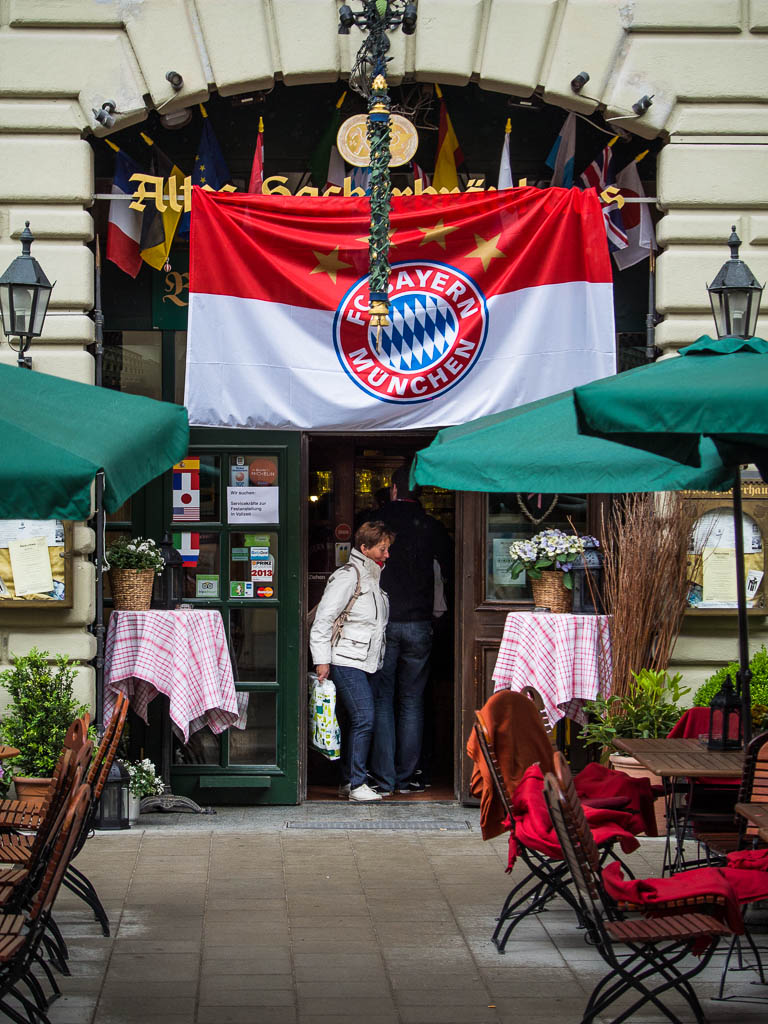
One of the smartest Bavarian restaurants  had done a little decorating


As had some of the cities mouments:


In the market, it was clear that today was going to be noisy and colourful.


And boozy, the side streets were full of empties, and this was 9 hours before kick-off - Bayern fans can pack it away.  Munich has no problem with public drinking, provided it is peaceable.


I headed into the city center, Marienplatz, where the fans were beginning to gather.  It was already clear that this was the place to be and that a situation was developing.  In the following images I have adopted a low saturation, high contrast approach to the processing, it is an affectation, but well represents the gritty dirty day.


As time went on (I was there for about 2-3 hours), the crowd built up and became louder:


At a certain point a group of cheer leaders emerged and started to orchestrate the crowd


All the time I was thinking about what the definitive photograph of the event would be, the peak moment, as it were.  I really enjoy working in a large and energetic crowd, but there is the problem of creating an image that is more than an amorphous  group of people.  I tried using the medieval backdrop to add some context, but I still found that I had interesting but not striking imagery.  It needed something more.


Something more came when the fans started releasing smoke flares, this added colour and movement into the  photographs


At the same time the police decided to get involved and enter the crowd, I think they just wanted to get the guys down off the statue before someone broke their neck


However, a single glance can add threat - a good moment, but not yet what I would call the peak.


THE NEXT PHOTO is where the peak came for me at least.  It is not ideal, I would like the police to be more prominent, but this is the point.  The crowd is active, the smoke adds drama and the backdrop places the event in old town Munich.  It took 2  hours of working in and around the crowd to get to this point, for me the defining image of the pre-game activity.


Before leaving Marienplatz, here is another shot with a different processing strategy.  Same crowd, same activity minus the smoke.  The bright colours make the situation look much less threatening.  Using the aggressive processing technique added to the sense of incipient violence, on a day when all there was was happiness and anticipation.  As photographers we can manipulate the real, by what we shoot, what we do not shoot and how we present our work.  This set of photos could be looked at as a threatening crowd almost out of control, fueled by alcohol and tribal passion.  What I have not included are the kids on their parents shoulders watching the fans and singing along, the bemused Chinese tourists and the shoppers just going about their Saturday.


PART 2

OK, so that was the pre-game "riot", what about the game itself?  I had intended to watch it at home, but a birthday celebration at a restaurant close to Munich's Leopold Strasse changed my plans.  Heidi and I met with her sister and partner for a great Lebanese and a few beers.  At about 8:30 we headed home, thinking to take the underground and walked into the cities biggest party in years:


Leopold Strasse is the heart of Munich's night life, an area full of restaurants, bars, nightclubs, cafes, it is all there.  All along the street every bar had widescreen TVs along the wall and thousands of people were watching the game.  All along the street small bars were selling beer and snacks, it was a great, if tense, party atmosphere.


Including the police.  A few weeks ago when Munich annihilated Barcelona in the semi-final there was a major riot here, bottles, baton charges the works, so this time the cops were there in force, but in truth watching the game as much as the fans.


Bayern scored first to great celebration, but Dortmund came back.   Bayern's winning goal came close to end of time and the sense of finally winning brought out the smiles and the flares.


Victory, closed the streets, all through the city people emerged onto the road and had a massive party.  God help anyone wanting to drive anywhere.  The police managed the situation, but did not intervene


So I finish with a final "Peak of the Action" moment, the joy of winning, the drug of success.


It was a great day, from start to end a riot of noise and colour, but without trouble, it was a celebration of the game of football and the city of Munich.