Sunday, February 3, 2013

Assignment 2: Final Revision


In my original commentary on this assignment, I made the following comment in the notes on learning:
“I consider this to be the most complete project I have yet to undertake as a photographer, it stretched me in so many different ways, physically and intellectually.  I hope that the assignment set works as well as the book, 13 photographs is a tough ask for such a diverse event.”
This comment was prescient.  The assignment essentially failed as a body of work, due in large part to the fact that I put too much of my energy into the creation of the book.  The book became the assignment, but this is not what was asked for.  The result was that I created the assignment as a summary of the photobook, rather than the other way around.  I each of my past 3 courses I expanded one of the assignments into a broader based study which then became a photobook.  However, as this was after the fact it did not interfere with the assignment.

Photobooks are an important part of how I think about and practise photography.  I find a narrative sequence of images far more satisfying than a single work of art.  I enjoy a monumental photograph, I much admire Andreas Gursky, but I find the photobooks of Martin Parr much more engaging as an art form.  My direction is pages in a book, not pictures on a gallery wall.  This is creating conflict in my studies, OCA assignments are on the whole a small set of images, generally fewer than 12.  I find this very hard to achieve; my comfort zone is 30-80 images. Perhaps I am copping out from making the hard decisions that a commercial photo editor might make.  I feel that the current courses are set up to drive towards the ability to satisfy a commercial brief, rather than for the artistic goal of an individual.  As I am engaged in this course to expand my photographic sensibilities as an artist, with no intent towards a career as a photographer, I have recently started to question whether I really want to continue with the OCA – there, I finally said it.

In effect this assignment has pushed me into a crisis of confidence and commitment, it has forced me to take a hard look at myself and my motivations.  For 3 years I have spent an average of 10-15 hours a week engaged in the pursuit of a degree.  I work 50-60 hours a week in a very demanding job, photography is the antidote to the long hours and stress, but now my photography is generating even more stress.  Why do I do it?  Vanity, maybe, I want to still prove my mind is capable of advanced study? Relaxation, well that went out the window a while ago?  Qualification, I already have 2 degrees and another postgraduate qualification? So why?

It is because I really enjoy the process of making pictures. I love the intellectual challenge of solving a pictorial puzzle and creating a photograph that entertains and challenges the viewer.

So the real question I must answer is how to pull myself back to a place where I am once again enjoying what I do and expressing how I see the world through photography.  I have an opinion about the world and a need to express it visually.  This is where I failed in this assignment, I dropped the opinion and tried to create an objective balanced piece of work.  As I did this I stopped relating to my subject and stepped into the position of an observer, even worse a voyeur.  I took too many photographs trying to document every aspect of the Fest and then present that in a book as a balanced view of the event.  As a book this worked well enough and I am very pleased with the outcome.  However, there was no practical way to reduce this to 12 or so images and retain the objective overview without resulting in a bland set of images.

In essence, by attempting to balance the set, I removed the more cutting images, afraid of projecting my opinion into the set of photographs – the net result a bland bunch of colourful snaps.  When I worked on my Landscape photographs I placed my personality directly into the images.  I am a geometry obsessed picture straightener and I used this to create a specific look to the photographs that conveyed a sense of Shaun.  With the subject of the Fest this was more difficult, I did not have the time to plan each and every frame, and I got lost in the chaos of the event.

Now the question, what am I going to make of this.  It is over 10 weeks since I submitted the original assignment. During that time I have taken a very deliberate break from my studies, giving myself a chance to clear my head and rethink my approach.  The answer is to return to where I was with Landscape.  I am not a disinterested observer, I have a strong viewpoint that I want to get across in my work.  Secondly I need to get back to my core interest in photography, the urban environment and the existence of people within the spaces they have created.  I find that my Landscape photographs have more Social Documentary in them than the images I have created for this course.

Assingment 2: Rework

When I started out with this study of the Oktoberfest my original plan was to document the seedy side of the event, to lift the carpet and show what is swept beneath.  The Fest has a very carefully constructed public image, one that the city is very keen to preserve, 100’s of millions of Euros flow from the event into Munich every year.  The newspapers always comment on the darker side, but the picture they portray is almost universally one of jolly lads in Lederhosen swigging gigantic beers and young ladies keen to make the most of their cleavage.  I rarely see the negative, even the shots of drunks tend to be humorous; this is one of mine, similar shots are frequently shown in the press:


The crutches add to the comic element, a bunch of lads sleeping it off.  What is never shown, however, are the fights, the people lying in sick and piss, the urgency of paramedics racing through the crowd to someone asphyxiating on their own vomit.  Worse still is the sense of sexual menace that permeates an event in which almost everyone gets seriously drunk.  Leering grabby men are everywhere, few women will get through an evening without some form of harassment, although many give as good as they get.  Sadly, sexual assault, even rape is not uncommon common at the Fest.  Many visitors have little recollection of where or what they did the night before.  Informed consent, no chance, although again it works both ways.

When I originally set out to illustrate this side of the event, this was the side that I wanted to portray, for a variety of reasons I bottled it.  I have now revisited those photographs and constructed an alternate narrative of the event, visiting on the darker side.  This is how I see the Oktoberfest, away from the picture postcards.  I have taken the 13 images that I submitted for the assignment and made a severe edit.  6 of the 13 remain, to which I have added 7 new photographs.  Of the 6 that I have kept all have been edited for framing.   In the new set I have freely cropped the photos without any limit of aspect ratio.  

My final and perhaps very risky move is a decision to switch the set to B&W.  When I first designed this assignment, it was the offshoot of a book project that had at its core, the colour of the Fest.  Changing the emphasis of the assignment to a darker view demands a rethink.  Visually B&W drives a graphical approach that places emphasis on the structure of the image.  The colour of the Fest that so dominated my earlier set is removed as a consideration, making the images less confusing and more focused.  It also enables better use of more marginal images, many of the seedier images were taken at or after nightfall under mixed lighting.  
However, this is not just about the picture qualities, the use of B&W has an effect on the viewer of the image that is outside the simple aesthetic impact.  B&W photographs are perceived as serious objects, they are reports not simply pictures.  By using B&W I can further emphasize that this is a documentary set that investigates and reveals, not simply illustrates.  

When I started out on this course I set out to shoot the whole thing in B&W, a direction that my tutor quite rightly questioned.  My reasons for using this medium were simply one of desiring to explore B&W across an extended period of time, not a bad thing, but also not terribly convincing.  He rightly pointed out that any decision regarding the qualities of my work should be for well thought out reasons.  With the Fest book, I used colour to portray the gaudy madness of this huge sprawling drinking event, it worked as intended.  Now that I am bringing focus to just a part of the event I have good reasons for using B&W.  During my Landscape course I shot 3 assignments and the portfolio in colour, the only assignment I shot in B&W was about the modern day presence of the Jewish synagogue in Munich, a subject that suited the darker tones of B&W.  

Learning

  • Technically there was little wrong with the original set of images, just an unwillingness to freely crop and frame the images to maximize the impact.  I think this stems from wanting tidiness in my work, something that worked in Landscape, but not here.  I need to always think about how the frame interacts with the image and treat the frame as a flexible tool.
  • Documentary photography is not science it is an art and as such permits opinions and the introduction of the practitioner’s personality and viewpoints into the work. In fact without doing so the risk is a bland set of images that merely record but do not engage.
  • The creation of Photobooks is central to how I want to develop as a photographer and is something I still see as the ultimate expression of my art.  However, I need to prioritize the demands of the course first.  I have a renewed commitment to what I am doing with the OCA and perhaps after this “crisis” I can get back into it with greater vigor and enthusiasm.

Reworked Photographs


This is how the world wants you to see the Oktoberfest, drunken of course, but happy.  The camaraderie of two revellers set against girls wearing Drindls and a sign welcoming all to the “Augustiner Garten”.  OK, that really is a great place to drink some really fine beer.

Among the broken glass, cigarette butts, and detritus of a day at the Fest a young couple find somewhere to escape from the chaos of the event.  By mid-afternoon the event is full and finding somewhere to sit and have a beer becomes a challenge. This is a rare departure from the horizontal for me, tilting the frame adds a dynamic to an otherwise static image.  I also want to convey the sense of disorientation that the Fest engenders after spending any time there.


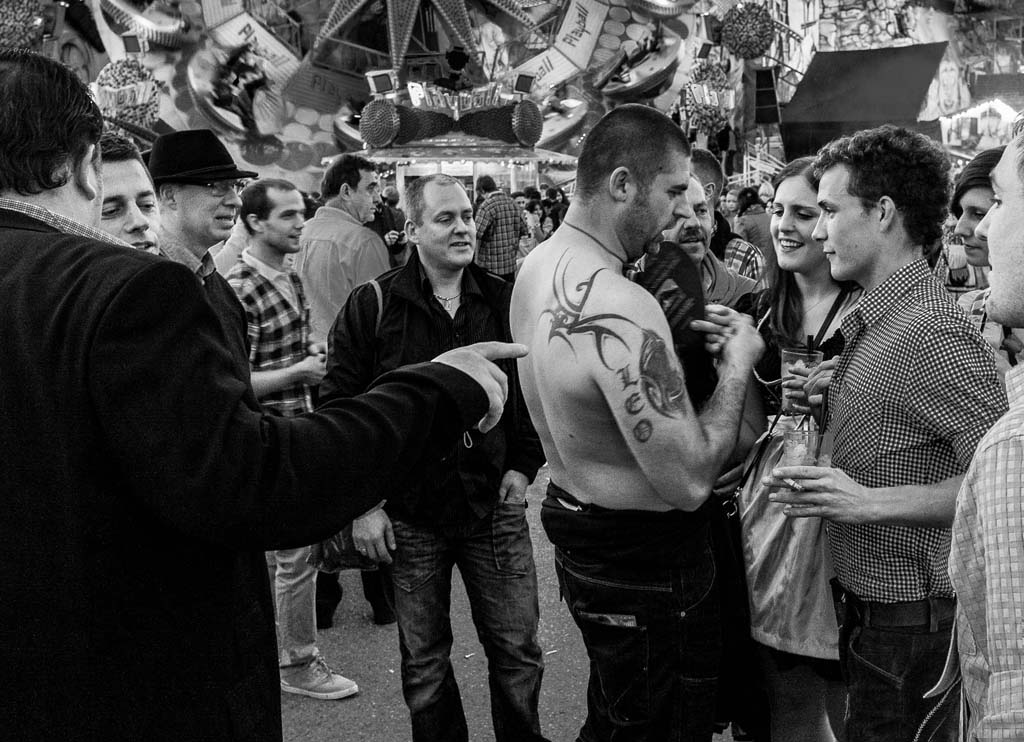
As the light falls the Wiesn becomes more intense, the crowds thicken and the music gets louder.  Everywhere you go there is drink. I have cropped this image much tighter to bring the emphasis to the tattooed man.  In my first submission I allowed much more of the background into this and several other photographs, the goal being to illustrate the event as well as the interaction.  This took the point of focus away from what I was trying to say.

Drunks lurch around the fairground, I become part of the game of jumping in front of cameras for a laugh.  In this case he made the photograph. Once again I have heavily cropped the original image to tighten the sense of his interacting with me and emphasizing the repetition of face in the billboard behind. 

This is a gently humorous look at the effect drinking 6% alcohol beer in 1 litre glasses, often with a Schnapps to chase it down.  I have tightened the crop to focus on the trio, removing the Hofbräu logo that was in the far left corner of the original.  The logo makes sense if you know something about the Fest, but without that knowledge it adds nothing whilst unbalancing the frame.

Forget the jolly opening image, this is how the Fest ends for many; wandering drunkenly soaked to the skin.  These two lads staggered across my viewfinder barely able to stand and utterly confused about who or where they were.

A frequent sight at the Fest, he just lost whatever it was he had for lunch. Equally frequent, though, is that people are rarely alone when drunk, there is a great deal of tenderness on display.  I have again cropped tightly to bring the centre of attention to the couple, but retained the boots in the background to suggest that they are part of a larger world.

There were a few chuckles, but these lads were taking good care of their comatose friend.  They had even taken their shirts off to help to keep him warm, hypothermia is a real risk for seriously drunk people at the Fest.  The Autumn air can be very cold and when coupled with rain can kill if someone escapes attention.

All too often the Fest ends badly for someone, alcohol poisoning or violence require attention from the emergency services.  They race through the crowd blowing whistles to alert people to make a path.

A sudden increase in the volume accompanied by crashing benches and breaking glass signifies that another fight has broken out.  Here we have one of the most primal of human interactions, violent confrontation.  This photograph nearly resulted in my joining the violence, the security guards were very aggressive about photo taking, something I reacted to badly.  That altercation, neatly illustrates the way that the Fest management want to control the message. 

Fest security is very efficient, start a fight and you will lose.  As with the previous image one or two of the bouncers took up position specifically to drive away photographers.  We call them the Black Sheriffs, they are known for their violence and I suspect a part of not wanting to be photographed is not wanting to be identified.  In a democratic world, when those in a position of power avoid being pictured as they go about their duties it is time to ratchet up the paranoia a little.

The come on! As night falls people start to pair off, the Fest is a major place for casual hook-ups.  Many go with the express intent of finding some casual sex, others simply take it.  Free condoms are distributed to try to manage disease transmission.  Conversely at least 3 couples we know first got it together at the Fest and are now happily married.  The Fest is a strange mix of contradictions.

The Fest is hard work, dancing drinking, shouting, many find a quiet place to chill a little before either heading back into the maelstrom or heading for the train home.  Others wake up in the room behind the wall they are leaning on and wish they hadn’t – the Wiesn Police Station.

Saturday, January 12, 2013

Assignment 2: Rethink

Well, it has taken a long time and a great deal of thought before beginning a response to my tutor's comments on assignment 2. Essentially the feedback was that I had produced a good set of photographs, but that I had missed the point.  I don't normally include the feedback in my blog, but this time I think it is important to add context to how I plan to respond.  These are the first 3 paragraphs in the comments:

  • You have continued to develop your own voice well with this assignment. I get the feeling that you are reconciling two different motivators - the need to meet the brief and following your own inclination concerning a particular photographic project connected with your own maturation.
  • You have succeeded in satisfying both aspects, but have been held back from following your natural inclination to fulfill the brief and in so doing have perhaps not succeeded with the brief as well as you are able. However, you have progressed very well in terms of progressing your own particular photographic development.
  • As before there is clearly a good deal of thought behind your work - including what you want to say and best to express this. You show good creativity and imagination in your execution of the work but your submissions lack a clarity in execution that I feel is born out of the split motivations referred to above.
This is not bad feedback, but it is quite critical and also valuable.  The key is the final sentence, a lack of clarity caused by split motivations.  It has taken me 6 weeks to work through my thoughts about this and get to the point where I feel comfortable enough to work a response.  I also had a long and useful conversation with my tutor around the assignment which helped me to understand where I had gone wrong.

The first and most fundamental problem was that I put all of my energies into developing the book concept and then created a set of images for the assignment submission as an afterthought.  In doing so I failed to editorialize my work and essentially presented a synopsis of the book with a nod toward human interaction.  I tried to be non-committal, objective, to avoid forming and presenting an opinion about the event I was documenting.  

I explored this theme in a previous blog entry, that asked questions about truth and objectivity in photography.  I considered a number of "opinions" that I could drive through my photographs of the Fest and was rather critical of Walker Evans' own editorialization of the photographs that illustrated "Let us Now Praise Famous Men".  This generated more comments on a blog entry than I have ever experienced, I think my choice of a sacred cow for a rather flippant critique touched a nerve - fair enough, with hindsight I now get it.  

Documentary photography need not be objective, indeed, it works better when the photographer has a statement that they want to make.  As with written journalism (thanks to Les Johnstone for making this point) photojournalism can have a viewpoint and project the political or social stance of the photographer.  This may seem obvious to some, but it was not to me.  I was laboring under the impression that I needed to avoid my own opinion of the event creeping into my images.

In summary, I presented a set of photographs that met the brief, but did little else.  What is worse is that the book contained material that could have produced a far more powerful assignment submission. My job now is to rework the assignment with this knowledge, taking on board the input from my tutor and adding something of myself into the set.  

My first decision must be where to take the assignment, what stance to adopt and why.  This is an easier decision than I thought it would be.  Whilst working at the Fest I progressively became overwhelmed by the excessive drunkenness and sense of impending violence that I observed as I walked around.  I was exploring the dark side of the event, both figuratively and literally, poking my camera into places the organizers would prefer to remain hidden.  What I was seeing was the impact of colossal drinking and the wreckage it left behind, an image of the Fest directly at odds with the jovial merriment the marketing wonks like to project.  I want my photographs to counter this image and convey that sense of menace and grime that is the other side of the Oktoberfest.  When I first set out with this project that was where I thought I would go, I chickened out.

The next step is to reassess the original assignment material, decide what to keep, what to adjust, and what to discard.  I then need to add new material to the set.  Waiting so long has allowed me to detach from the original material and approach it with a new mind.  Here are the 13 images submitted to my tutor marked up for edit:


In essence I am removing the more anodyne images, then editing the remainder for greater impact:


Although I am planning something dark, I still need one or two images that contrast that point, so not all of these are so gloomy.  However, all contain drink and most a degree of threat or collapse.  My next task having removed 6 images is to think about how to replace them.  That will be the next step and a process that might also result in changes to the above images.  I have 24 images (including the above) from which to select, once again I have produced a set of contact sheets to illustrate:


I have direction now, but still a large task ahead of me, getting down to 12 or so photographs is still a major task, but I feel a lot more positive about the set now.  A key will be to keep in mind the original brief, that this is a set about human interaction, which illustrates the dark side of the worlds biggest drinking competition!

Thursday, January 3, 2013

P16: urban Life

A simple and yet challenging project, urban life encompasses so much and is all around me, yet how to capture and present it.  My entire course is intended to be a study of urban life, how people interact with the artificial environment of the city, at home, during festivals, or simply carrying out the day to day activities that make up modern German society.

I have opted to work to a theme for this project, a brief study of the Munich Christmas markets.  At this time of year almost every neighbourhood attracts a cluster of huts selling decorations and handworked Christmas presents.  At the heart of each will be a Gluewein stand and a collection of huts selling grilled bratwurst, flammkuechen, and other delights that simply taste so much better for being consumed in the open air. This is an intrinsic element of Munich's calendar, the opening of the stands on the first weekend of advent is greatly looked forward to, it represents the start of the festive season.

As well as being a chance to capture the spirit of the season a crowded Christmas market provided an opportunity to practice some candid photographs and practice my street skills.  The following photos are from just two Christmas markets, the main one in the center of Munich and the market in the middle of the Englischer Garten, Munich's principal park.  The latter is a magical place, far from the busy streets, so quiet and with no overhead street lighting.  My camera of choice was my Fuji X100, small, discreet and with very good low light abilities.  These are places that need to be photographed at dusk to get the best out of the lighting.  I used the cameras tiny flash as a fill light to pull up the lighting on peoples faces.  It also created some interested effects in the falling snow.

My first image is of one of the Gluewein stands just in front of the town hall.  Christmas markets are a very inclusive tradition, young and old, the cool and not so cool, all enjoy a glass or two and an opportunity to shop.  These guys posed for me and somehow this captures the old and the new.


A rather simple shot, but one that tells the story, people shopping or simply enjoying looking at the myriad of colourful decorations in the stand.


When taking this set it was important for me to try and capture the interaction of the people with the stands, but also in a candid manner.  I found that positioning myself at the end of the stands shooting along them took me out of peoples eye lines, but still provided the opportunity to capture interaction, whether a simple glance or a more involved transaction.


I particularly like the next image, it captures the spirit of the market, it is very hard not to smile at a Christmas market.  In this and the latter image I have cropped to a square format, eliminating unneeded background and bring the focus of the viewer to the subject.  A lesson learned from my assignment 2 debacle is to vary the framing.


Now moving to photographs taken in the park and in the snow.  The following photograph uses a long shutter speed with the risk of blurring (1/10s), but the detail is still good enough.  I do find that my ability to hand hold the smaller X100 is far better than with DSLRs, even though the X100 lacks image stabilization.  Here the longer exposure has caused the falling snow to streak across the frame, adding to the sense of cold.


Even though it was bitterly cold, the market was packed - this was a Sunday evening, most popular day of the week for the markets as the advent Sundays are very symbolic here as part of the Christmas count down.  This show needed dusk lighting to work, flash was not going to help for such a wide image.  This is an illustrative shot.


On a similar vein the following is also an illustrative shot, an attempt to capture the falling snow in the lights and the crowds flocking through the market.  With this and all of the other shots I have exposed for ambient light and then used flash for fill in.  ISO is almost always 3200, I leave this on an auto setting, telling the camera to try and give me 1/100s for the shutter speed.  The Fuji image quality is fine at  ISO 3200, but falls over a cliff at 6400 and beyond.


 My parting show is of the people who make the market work, the Bratwurst grillers, without them the markets would be far less fun.  Here the fill flash has lit up the snow and created the specks at the bottom of the frame.  Underwater I try so hard to avoid this effect, here it adds to the atmosphere.


Well, that was Christmas in Munich, each year is the same, and thank goodness for that.  The tradition of the Christmas markets is many hundreds of years old and very treasured by the citizens of Munich, a true urban tradition and a key to enjoying this time of year.  Perhaps this is not the urban photography the project had in mind, but I am almost entirely shooting in the city so will get plenty of practice over the coming year.

That completes the compulsory projects for Chapter 1.  I missed the two optional ones, I may return to them time permitting, but neither are of particular interest to me.  I have much work to catch up on, I am already working on my thoughts for Assignment 3, which should be at the end of Chapter 3.

Wednesday, January 2, 2013

Up & Down

A new year, but no resolutions!  I don't need a change in the date to think about how to live better or start new things, this is something that should be part of each and every new day.  However, it does mark the end of December, a month during which I very deliberately put my OCA studies on hold. I needed a break, both from work and from studying.  Christmas is a hectic time with many conflicting demands on time, adding my course into this mix would just have created additional unwanted stress.  So I took a break!

Another motivation for a pause was mixed feedback from my second assignment, it was not really what I expected and I have needed some time to think about it and consider how best to respond.  I will address this in more detail in a future post, but the essence is that my tutor felt that I did not engage closely enough with the subject, that I was too impartial in judgement, and that I lost focus on the interaction element of the assignment brief.  The second point is the one that I have most difficulty with and will requires a major change in how I approach the remaining parts of this course and how I rework the images for Assignment 2.

My understanding of social documentary has missed the mark.  I am thinking about the subject as I would a scientific project, with the idea that I must document society, which with my prior education suggests an impartial and objective viewpoint.  In the work around the Fest, I attempted exactly that, to visually describe this immense social gathering, but trying not to let my own prejudice or viewpoint enter into the work.  The net result was that I described the event well, but there is little of me in the images.  I must remember, ART, not SCIENCE!  Art has a viewpoint, a statement of belief, an opinion on the world - it need not and perhaps must not be impartial.

Just after receiving the assignment 2 feedback I also got my grade for Landscape, 75%, a solid first!  Good news, but also room for improvement, although given where I am right now with Social Documentary, it is not going to be easy to do that with the current course. Looking a little more deeply, here is how the mark broke out:

Demonstration of technical and visual skills - 30/35
Quality of Outcome - 15/20
Demonstration of Creativity - 15/25
Context - 15/20

and the comments:

"Excellent, the progression is palpable through the course. Maintain that profound personal investment
into the following modules. You should continue to tune your appreciation of what makes for a
photographically fine print, there is a good development in print quality in the submission from
beginning to end but there is still a step or two to go."

As ever the feedback is cryptic and needs some thought.  My biggest issue is clearly the 15/25 for the "Demonstration of Creativity".  I think this points to my choice of relatively safe subject matter.  During the course I pushed the definition of Landscape quite far, but very firmly remained within my comfort zone, I think I need to push the envelope a little more.  Technically I have no real problems, something also stated in the SocDoc assignment feedback and I am roughly where I need to be with the quality of my finished work.

The comments are challenging,  clearly my printed work needs further refinement.  OK, but what is it that is still lacking?  I haven't a clue, however, I will in any case continue to explore what makes a good print and work to get the best out of my printing workflow.  Recently there has been much discussion on the forums about printing, with many level 1 students wanting to submit purely digital work for assessment.  I think this is mistaken, even if a photographer sees the web as their medium all will at some point need or want to print.  The photograph as a physical object in the real world remains, for me, the ultimate expression of the art.  Printing is a key skill to develop and not an easy one to master.  It is also expensive, but I think something that should be budgeted into the planning for a photographic degree course.  I am fortunate that cost is not an issue, for me it is time - printing is extremely time consuming, but so worthwhile.

So where does this leave me?  Good and not so good feedback.

I started this commentary with the clear statement that I am not doing New Years Resolutions this year, however, I do need to make some changes to what I do and how I do it.

The first clear input is that I need to make my work more personal, to allow my opinion to enter my work and use photography as a vehicle to present my view on the world.  In the real world of a working photographer this "view" might be that of the client commissioning some work, I currently have the luxury of providing that view.  I do think that I need to take care, a viewpoint can easily become a prejudice, and this can negatively impact how others see my work.  To help me to develop this further I need to spend more time with the work of other photographers and look at their work to understand what their opinions were and what the message is.  I buy a lot of photobooks and spend far too little time considering their content in a critical manner.

Secondly, I need to continue to refine and develop the quality of my final output, I do too little printing and need to be a lot more critical when I do so.  I have a carefully calibrated monitor to paper workflow, so I see on a print pretty much what I see on the monitor.  However, I do not examine the prints very carefully and still perform mostly global adjustments to my prints.  Work for assessment needs to be far more carefully prepared, each part of the print carefully produced.  I also must think more about how I balance images with the frame and where to crop.

Finally, I need to reassess what I photograph as part of social documentary.  I was successful with landscape, but am now struggling with the people orientated social documentary.  It is not that I find photographing people challenging, I am just not very interested in them.  An answer might lie in looking at the boundaries between landscape and documentary, taking the bigger picture, but still thinking about society.   The course is written with people as the subject, however, Social Documentary need not be about people, it could also be about the spaces they occupy, places that echo people.  With my Fest work this was not an option, however, as I look at Robert Frank's work I see many photos that would fit into the viewpoint.

I guess the bottom line here is that I need to spend more time thinking about what it is that I want to say and then develop techniques and practices that enable me to say it clearly and in a manner that engages and interests the viewer.

Thursday, December 27, 2012

B&W

Well, Christmas is finally over and I can get back to thinking about my ongoing study of the art of photography.  I have very deliberately taken a break from creating photographs, reading about photographs and writing about photographs, the 3 tasks that seem to fill any free time recently.  I am running the risk of becoming too engaged with the subject and becoming frustrated or worse, bored with the whole thing.  On the other hand it is time to get back in the grove,  I have much to do in the new year. I must rework my 2nd assignment, begin to think about the essay and catch up on much of the project work I have left undone.

Before all of that, I want to revisit a personal project, exploring the use of medium format film as opposed to my arsenal of digital cameras.  Just before the festivities I was able to collect my first B&W negatives from the processor, the first roll of film that I put through the camera.  The first key learning has been that B&W takes much longer and is far more expensive to process than colour, quite the reverse of the situation were I to do it myself.

The second big learning point was astonishment that on a cloudy day I was able to shoot at ISO 100 and still get blur free images, not a single frame had issues with camera shake.  I did not write down the shutter speed I used but it was around 1/30s, well below hand held range with a DSLR and 80mm lens, even with IS.  My admiration for the camera and its integral leaf shutter grows and grows.

The final bit of learning from scanning the negatives was that dust is not a small problem.  Oh boy, and there was me thinking that I had left behind the issue of sensor contamination.  However, I am pretty sure I know the problem, I cleaned the scanner with an old duster just prior to scanning.  I now have  a brand new microfibre cloth and some spectacle lens cleaners that I hope will fix the problem for the future.


Again I find that the medium format camera and in particular the square framing supports very precise alignment of objects in the frame and enables the minimization of vertical convergence of parallel lines without use of expensive perspective control lenses.  It is not all goodness, though, the final shot well illustrates the limitations of the medium, the ISO 100 film has forced me to use a wide aperture and I have insufficient depth of field to properly render the scene.  The second shot in the sequence takes advantage of that limitation, but clearly shooting film implies constraints that I do not suffer with Digital.  On the other hand a 4th lesson learned is to use ISO 400 film in the future unless the light is very strong.

This is still pure play, enjoying getting to grips with a new medium (to me at least).  I have another 2 colour films in for processing and a further 3 B&W waiting for me to develop.  I must still question why I am doing this and where it might take me for this course in particular.  I am enjoying the look of film and with my need to shoot in the style of Robert Frank, perhaps film might help, although 120 film and slow careful shooting was not really his modus operandi.  I do need to spend more time with the camera and see how it works into my current projects.

One thing for sure, it is teaching me the value of patience and forcing a slower more contemplative approach to my work.  This might not, however, be a good thing.

Monday, December 17, 2012

My First Colour Film

OK, I could have written one post on this, but there was quite some time between getting the camera and then getting the negatives, so I am splitting this into two.

This is actually not my first film, that was a roll of ISO 100 B&W.  Lesson #1 in the new world of film photography, B&W film takes ages to get processed, colour is no problem.  I think it used to be the other way around.  I'll post some B&W images if they ever come back.

However, I shot both films in the same area at the same time to have a basis for comparison.  The goal here was to learn the camera and see what I could achieve.  The colour film is ISO 400 Kodak Portra.  Lesson #2, ISO 100 is too slow on a cloudy day, boy did I miss the ability to up the ISO as and when I wished.  If there is a single most important benefit of Digital, auto ISO is it!  Even with ISO 400 film I had to work at getting a shutter speed that would work for me.

But, wow, the camera was a joy to use.  The huge bright viewfinder made framing so much more precise, the manual focus worked well and was quick enough for the imagery I was creating.  This is not a fast action street machine, but you are very sure on what you focus.  The leaf shutter is almost silent, it is hard to tell that the shot has been taken. The lens mounted aperture ring is pretty similar to my X100.  On the whole it was quite similar to using the X100, but just so much more precise.

A key change is the 6x6 format and the resulting square frame, very different to the 3x2 of a DSLR.  This genuinely changed how I framed.  The foreground and background become very much more important and have to be thought about much more than with a 3x2 camera.  I find that I read the photos from front to back, rather from side to side.

The other big change is the manual nature of shooting, every shot needed to be thought about.  The camera has an excellent exposure meter, however, a snowy day meant constant adjustment.  I was also conscious of 12 shots per roll of film and the fact that each photo consumes 1 euro, but this is not a big issue.  I don't buy into the need to use film to slow down, this is a lame excuse, simply slow down, digital cameras only work when the shutter button is pressed.

So how did I do?  Not great, but not bad either.  I have scanned the negatives on my Epson V700 scanner.  This was a rather magical process, to tell the truth, placing these oddly coloured sheets of plastic into holders and then seeing coloured images appear - OK it is not like wet printing, but still rather nice.

My subject was the Isar river and my continuing personal project to document the river as it flows through the city center.  The photos are underexposed a little, the flat white sky and snow on the ground made judging the exposure quite tricky.  However, the overall colour quality is super, very different to digital, and the detail is good.   What I do notice is the exposure latitude. Although they are all a little too dark (I can change that, I know,but chose not to for this exercise) nothing is blown out, I have extreme variations between light and dark in some images and yet there is no loss of detail.  The S curve of film sensitivity truly preserves detail in ways that a Digital sensor cannot.


So far, so good.  I am very happy with this experiment with analog photography.  One final thought, a philosophical point to finish with.  A camera is simply a box with a hole at one end, a device at the other that records light and something in between that determines how much light arrives at the recording device.  Mechanical, Chemical or Digital, the basic processes are the same, a film is a device for recording the number and energy level of photons striking a fixed point in space, a digital sensor does the same.  What happens afterwards differentiates them, not what happens when the shutter opens and closes.

Trying something different

For the past year or so I have been using smaller less versatile cameras, trading the function of a DSLR for a lighter more discrete package.  It started with a Samsung NX100,  then followed with a Fuji X100, and most recently a Samsung NX20.  The Samsungs are system cameras, pretty much miniature SLR's with interchangeable lenses of remarkably good quality for their size.  Conversely, the Fuji has a dedicated 23mm lens or 35mm in real money, an almost ideal focal length for street and urban landscape work.  Although the Samsungs are versatile and produce great images, the Fuji is my go-to camera.

I am increasingly finding that I gain from using a fixed focal length lens, an image must be framed using position and movement, not a simple twist of the wrist.  This forces engagement with the subject and a better understanding of the environment I work in.  The fixed focal length also means that the lens can be optimized for the camera, the sensor and lens are a single fixed entity; the Fuji consistently produces better results than any other camera I own.  As I gain more experience in photography I am progressively simplifying how I take photographs.  I am still a gear head with more cameras than sense, but one with changing priorities and expectations from my equipment.

What has surprised me is the extent to which the camera used influences the results created.  It is not the image quality that really matters, the high ISO,  the pixel density, or the fine Bokeh of a fast lens.  It is the feel of the camera in hand, the brightness of the viewfinder, and the comfort of use, that makes the difference to being able to create a good "interesting" image. If I am comfortable with my camera I work better, I feel more relaxed and am more creative - to use a cliche, I am in the zone, where my camera becomes an extension of mind.  When I first used a DSLR I was intimidated by the controls and options, retaining a nagging doubt that my photos were crap because the "settings" were wrong.  Too much technology.  Nowadays, I put the ISO on auto, set the camera to Aperture priority, and just try to make sure that the shutter speed is fast enough. A couple of days ago it took me half an hour to figure out how to use the flash on my X100, I simply never pressed that option before...

I guess the point I am making is that technology had started to get in the way of making photographs.  I have started to use digital cameras as if they were analog cameras, so it was only a matter of time before this happened:


Meet my new friend a Fujifilm GF670, a 6x6/6x7 medium format rangefinder with a fixed 80mm lens and that novel feature, a chemical sensor...  Back to film, and also to a form of film I have never used, 120 medium format.

For some time I have been trying to lose weight largely through cutting my beer consumption, thus every time I consumed less than 10 beers in a week I added 50 Euros to my camera fund.  A few weeks ago this stood at over 2,000 Euros and I felt very much healthier.  My intent was to use the money to buy a new mirrorless format camera, a Fujifilm X-E1 and a few lenses, however, when it came to it I stopped.  It was not the cost, but the question of whether this would change anything, it is a very sexy camera, but in truth not that different to my Samsung kit and I already had the excellent X100.

So, I decided to spend the money on something that I believe will add something to my photographic journey.  The GF670 is almost a film incarnation of the X100, similar effective focal length, similar lack of ability to zoom.  OK, no Auto ISO, but a good light meter and Aperture priority shooting.  In other words it is a camera and does what a camera does, just with fewer buttons to get in the way of creativity.

So why am I doing this and what do I expect to learn.   Good question, and one that I am not sure I can easily answer.  To paraphrase Garry Winogrand, part of the reason is that I want to see what the world looks like on film.  But, I am not sure yet, I am open minded about this.  I missed the whole film thing, photography for me has been a digital world from the get go - excluding the holiday snapshottery I used to do with old 35mm automatic cameras.  I am curious about film, but have no nostalgia and mostly bad experiences.

The one motivation I can definitely point to is a need to create a tangible object with the camera, that goes beyond GB of digital data.  This stems from my recent project to scan and archive boxes of family photos.  I was struck by the physical nature of the prints and also by discovering the remarkable quality of what were tiny contact prints from 120 roll film (negatives were lost long ago).  These little images contained details of relatives lost many years ago, many whom I never met, their existence now contained only within these prints.  This made photography real to me in a way Digital never has.

Continuing the need to create a tangible object, my birthday was a few days ago.  My present from Heidi, a B&W roll film developing kit.  I really believe that this will provide a greater sense of controlling the photographic process, to gain a sense of being an artist who actually makes something that can be touched and held.


I appreciate that in all of this there is still the contradiction that for the photographs to have any presence in my world they will need to be scanned, uploaded and shared digitally.  Whilst developing makes sense, a wet darkroom does not.  This will be a marriage of the analog and digital worlds.

The beginning of a new photographic journey

Monday, December 3, 2012

The Isar

The feedback from my last assignment, the Oktoberfest, was not good.  I somehow missed the point and delivered an incoherent set of images.  The problem did not lie in the images or technique, but in the intent.  I had tried to rise above having a distinct opinion or stance versus the Oktoberfest, resulting in a set of images that described but did not explain.  My wish was to avoid being judgmental, to present the event as it is rather than as how I saw it.  This was a serious error of judgment, every photographer, no matter how objective, must put a part of themselves into their work.  I should have taken a position and then developed a visual narrative that spoke to that.  Instead I rambled.

Rather than see this as failure, I am taking it on the chin, it is possibly the most important learning experience I have yet to have with the OCA.  In failure I can learn and adapt to a new view on what I create and how I present it.  I will return to the Fest work and create a new narrative based upon my own experience of the Fest.  This post is not that discussion, this post is about what to do next and how to develop further as a photographer.

I have learnt much during the first two assignments in this course.  I can photograph people, both aware and unaware, I can work the street, I am not afraid of getting in people's faces, but I don't really enjoy it as much as I should.  This is not in itself a problem, education should be fun, but some things are more fun than others.  I am starting to see this course as part of the process of developing as a rounded complete photographer, building skills and an understanding of photographing the person, but it is not where I see myself going in the future.

I just got my marks back from the Landscape course, 75%, a good first, but with plenty of room for improvement.  Looking back, there are at least 2 assignments in that course that would equally have worked in this one.  The emphasis was on place, but people were almost always occupying that space.  Although the current Social Documentary course places a heavy focus on people and people in close, the practice of social documentary is about documenting society.  Society can be described and imaged in many ways, it need not be close ups of individuals, indeed I would argue that documenting society should be as much about the traces of people as the people themselves.  In a sense that is what my Landscape course was about, the evidence of people in the landscape.  One constant comment about my Fest work was that I did not crop close enough, in fact I had deliberately widened the angle to ensure that the infrastructure of the Oktoberfest was in the photos as I felt this had a key descriptive purpose.  Clearly my instinct was still to place people into their environment, not to exclusively focus on the people.

Having now completed two assignments that closely focused on people as the subject, I now want to step back a little and perhaps do work that could best be described as a social landscape, to follow my instinctive impulse to contextualize human activity within the environment it occupies.  To that end I am embarking on a short (or maybe long) personal project that examines the Isar river as it flows through the city of Munich.  The city center is just to the West of the river and the original city fortifications extended almost to the river.  The Isar is the origin of the city, the water that enabled people to settle here and the defensive line that protected the city.  The Isar is an Alpine stream grown large, the water still pure enough to drink and even in summer ice cold with the melt from the Alps.  In most places it is broad and shallow, but in parts has been channeled and deepened.  Sometimes the banks are roads and tall buildings, elsewhere wooded parkland, but always changing, always interesting.

My study will cover the length of the river through the city, flowing for roughly 5 miles from South West to North East:


In this satellite composite the bridge at the North carries the outer ring road and is probably the furthest point I will explore.  Walking South the green area on the left bank is the Englischer Garten, Munich's huge central park and the site for many of my landscape photographs.  About half way down and to the left once more is the medieval center of the city, just opposite where a large series of islands split the river.  The large oval area with white tents is the Wiesn, site of the Oktoberfest.  Finally as we go to the south the river meanders and the shallow bed can frequently be seen.  Normally this is a quiet and gentle stream, but in spring if a major rainstorm coincides with the Alpine melt, it becomes a dangerous torrent capable of flooding the lower reaches of the city.

My goal is to study the river and its surroundings, looking at how the river influences the city and it's people, and vice versa.  I am not too sure where this will go and once complete what I will do with it, but I think it makes sense right now to do something that I want to do, not driven by any need to create an assignment or produce a photobook.  However, this is a still a project from which I hope to develop and is a vehicle for exploring where I want to go photographically, especially as I approach my final year studies.  There is an element of wanting to stay in touch with Landscape photography and not be consumed by the current course, hopefully I will be able to merge the two at some stage.

A few days ago I started this project, exploring the river from the bridge that crosses to the Chinese tower beer garden down to the bridge next to the Deutches Museum, a stretch of roughly 2km.  Within this area the river has been straightened, but still retains a very natural aspect when seen from the bank.  It is only when pulling back and widening the view that it is clear that the river is within and urban space.  This is a part of what interests me about the river, the ability to appear perfectly natural and yet be very much a part of the city


Structurally the bridges are fascinating, mostly single span arches, they create a strange other worldly space beneath them.  The following photo also illustrates the changing nature of the river.  I am standing on the river bed, very empty now that it is winter.  The upstream water that would feed the river is now falling as snow and starving the river of its flow.


Trees line the river, but in winter the buildings that fringe the bank can be clearly seen enabling the construction of layered images such as these.


As the river splits around islands, giant damns and weirs are used to manage the flow.  In these cases there is an interesting juxtaposition of the massive concrete structures and the more delicate stone of the older buildings lining the bank.


So gar I have been working very much with a landscape aesthetic in mind, now I switch to something more aligned to social documentary.  Sadly, or perhaps marvelously, structure along the river are heavily decorated by the local street artists.  In places I like their work, here it creates a colourful strip along a walkway under a bridge.


Elsewhere the effect is less pleasing to the eye:


However, the city gets it, they stopped fighting the graffiti and in places embraced it.  This passage drops beneath a major road leading to one of the bridges, enabling cyclists and pedestrians to continue to follow the river bank path uninterrupted.  This used to be rather intimidating, now it has been transformed into an urban art gallery.


Conversely, there are areas on the river where the city has less control.  Just adjacent to the Deutches Museum, Germany's pre-eminent technology museum, a parallel to the Science museum in London, things are less clean and well managed.  In the gloomy underneath of the bridge, can be seen the detritus of ruined lives, syringes are scattered along the wall...


As I mentioned at the start of this post, I am not sure where I am going with this, I have no plan, simply a need to do some photography that I enjoy and that speaks to my own tastes and outlook.   These images are that aesthetic, a description of a place and the evidence of people within that place.  It will be interesting to see where this goes.  Right now I am just along for the ride.